
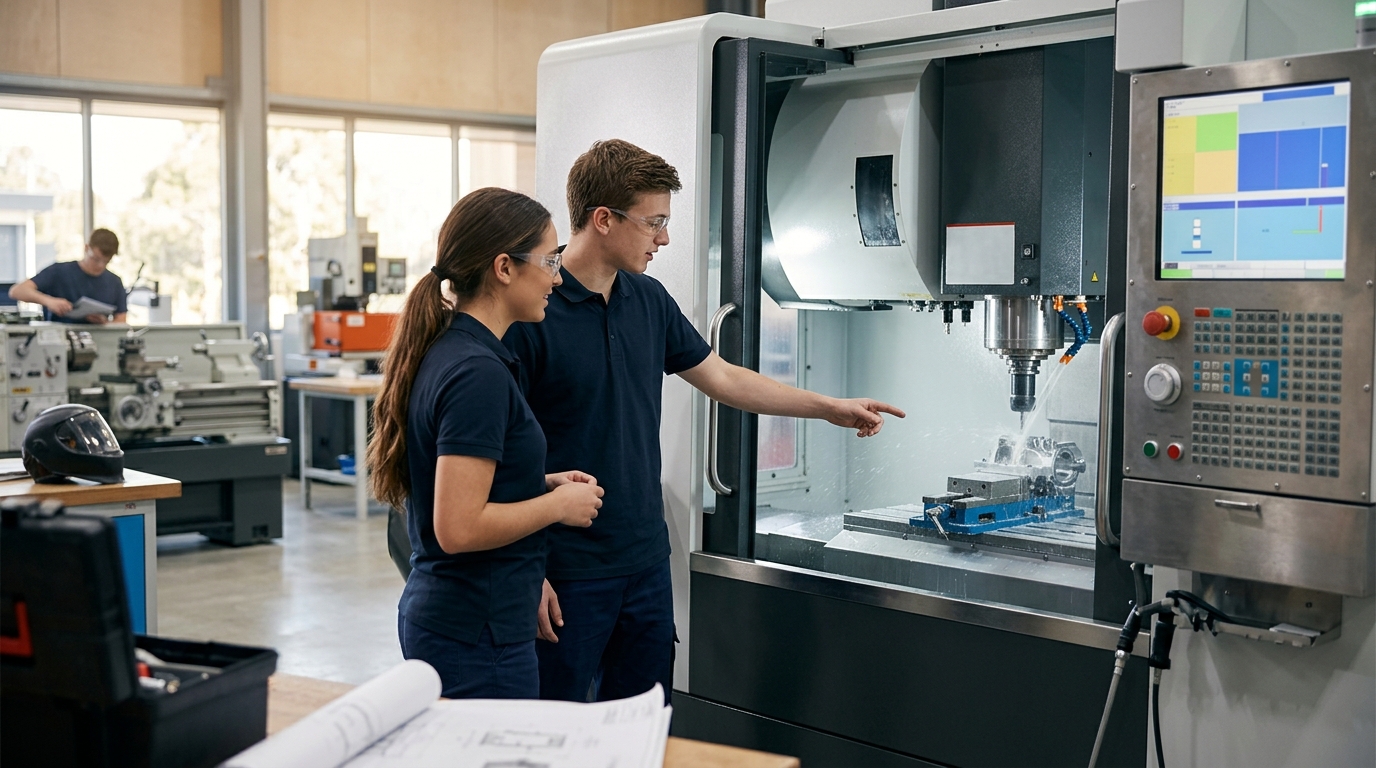
Education institutions across Australia are currently prioritizing the integration of advanced manufacturing technologies to prepare students for Industry 4.0. Recent industry reports indicate that over 60% of technical colleges have upgraded their CNC and EDM fleets in the last five years to meet modern workforce demands. This shift reflects a broader trend where theoretical knowledge must be paired with hands-on experience on production-grade equipment. (Why QMT About us)
Educational Focus and Industry Alignment
Australian Technical and Further Education (TAFE) institutes and universities operate under strict guidelines to ensure their graduates are job-ready. The curriculum is no longer just about manual machining. It now encompasses computer numerical control (CNC) programming, additive manufacturing, and precision metrology. This evolution requires institutions to invest in machinery that mirrors commercial workshop environments. (Blog QMT Machinery)
The gap between academic training and industrial application has narrowed significantly. Students must now understand the nuances of tool paths, coolant selection, and machine maintenance. According to recent workforce development data, employers in the manufacturing sector report that graduates with hands-on experience on specific machine tool brands are hired at higher rates. This reality forces educational leaders to select equipment that offers both durability and advanced functionality. (Brands QMT Machinery)
Institutions like Chisholm Institute, located in the heart of Australia’s manufacturing corridor in Dandenong, Victoria, exemplify this approach. They train the next generation of skilled metalworkers by providing access to state-of-the-art facilities. Their success is built on partnerships with equipment providers who understand the unique pressures of an educational setting. These providers must offer machines that can withstand heavy daily use while maintaining the precision required for academic grading.
Core Equipment Categories in Training
To deliver a comprehensive engineering education, institutions typically deploy a mix of manual and automated machinery. This hybrid approach ensures students understand the fundamentals before moving to complex automation. The following categories represent the standard toolkit for modern Australian engineering programs.
Milling and Machining Centres
Milling machines are the backbone of any mechanical engineering program. They teach material removal, surface finishing, and geometric precision. Institutions often start with manual milling machines to build foundational skills. These machines allow students to feel the cut and understand feed rates without the interference of software.
As students progress, they transition to CNC machining centres. These machines offer multi-axis capabilities, allowing for complex part geometries. Large machining centres are particularly valuable for universities focusing on aerospace or automotive mould making. They provide the rigidity and power needed for heavy material removal, simulating high-volume production environments.
Turning Machines and Lathes
Turning operations are essential for teaching cylindrical geometry and thread cutting. Manual lathes remain a staple in TAFE curricula because they force students to master hand-wheel control. This tactile learning experience is difficult to replicate with automated systems. However, CNC lathes and turning centres are increasingly common for teaching automated workflows.
The 2025 buying guide for manual lathes highlights their enduring relevance. While automation is growing, the manual lathe is still considered a cornerstone of precision machining education. It teaches patience and precision in a way that CNC machines cannot. Institutions that retain manual lathes in their fleet ensure that students have a deep understanding of the mechanics behind the automation.
Grinding and EDM Machines
For advanced manufacturing courses, grinding and Electrical Discharge Machining (EDM) are critical. Surface grinders and cylindrical grinders teach students about micron-level tolerances. These machines are often used in quality assurance modules to demonstrate the importance of surface finish.
EDM machines, including wire cutters and die-sinking units, are vital for teaching non-traditional machining methods. Wire EDMs are particularly popular for creating intricate shapes in hard materials. Die-sinking EDMs are used for mould and die making, a key industry in Australia. Understanding the difference between wire EDMs and sinker EDMs is a core competency for advanced students.
3D Printers and Metrology
Additive manufacturing has become a standard part of the engineering curriculum. 3D printers allow students to prototype designs quickly and iterate on their ideas. This technology bridges the gap between design and production, teaching students about material properties and layer adhesion.
Metrology equipment is equally important. Without precise measurement, machining is guesswork. Institutions use coordinate measuring machines (CMMs) and other metrology tools to teach quality control. Students learn to use calipers, micrometers, and optical comparators to verify their work. This emphasis on measurement ensures that graduates can meet the strict standards of the manufacturing industry.
Strategic Brand Partnerships
Educational institutions do not buy machinery in isolation. They rely on established partnerships with reputable manufacturers to ensure they receive the best support and training. The choice of brand is often driven by reliability, service availability, and educational programs.
QMT Machinery has built its reputation on partnering with global brands that meet stringent qualification processes. These brands are proven through decades of industry experience and are supported by service teams that can provide immediate assistance. For educational institutions, this support is crucial. Machines in a TAFE or university setting are used intensively, and downtime can disrupt entire semesters.
Brands like King Rich are trusted by Australian workshops for their durability and accuracy. These machines are designed to hold up under daily use, making them ideal for educational environments. Vision Wide is another brand that offers reliable equipment for various machining needs. By working with these manufacturers, QMT ensures that its educational partners have access to high-quality machinery that will last for years.
The commitment to quality without compromise is a key factor for institutions. They cannot afford machines that break down frequently or require constant repairs. The brands partnered with by QMT Machinery are selected for their ability to deliver consistent performance. This reliability allows educators to focus on teaching rather than troubleshooting equipment issues.
Service and Remote Diagnostics
After-sales service is the backbone of trust in the machine tool industry. Educational institutions need more than just a machine. They need a partner who can provide ongoing support, training, and maintenance. QMT Machinery has stood behind every machine with relentless support since 1967.
One of the most significant advancements in service is remote diagnostics. This technology allows technicians to access machine data and diagnose issues without being on-site. For institutions in regional Australia, this capability is invaluable. It reduces downtime and ensures that problems are resolved quickly. Remote diagnostics also provide real-time insights into machine performance, helping educators identify trends and prevent future issues.
The integration of internet-based service tools has scaled up support efficiency. Institutions can now receive proactive maintenance alerts and software updates. This level of support ensures that the equipment remains at the cutting edge of technology. It also reduces the burden on internal technical staff, allowing them to focus on student instruction.
The commitment to long-term performance is what sets QMT apart. They do not just sell machines; they invest in the success of their customers. This includes providing expert technicians and a supply of genuine parts. For educational institutions, this means that their investment is protected for the long haul. They can rely on QMT to be there for the duration of the machine's lifecycle.
Equipment Comparison for Institutions
Choosing the right equipment for an educational program requires careful consideration of various factors. The following table compares common machine tool categories based on their educational value and application.
| Equipment Category | Primary Educational Focus | Industry Application | Recommended For |
|---|---|---|---|
| Manual Milling Machine | Hand-wheel control, feed rates, material removal basics | General engineering, maintenance workshops | Beginner students, foundational courses |
| CNC Machining Centre | G-code programming, multi-axis operations, automation | Aerospace, automotive, mould making | Advanced students, specialized tracks |
| Manual Lathe | Cylindrical geometry, thread cutting, precision turning | General machining, repair work | Beginner to intermediate students |
| Wire EDM | Non-traditional machining, intricate shapes, hard materials | Mould and die making, tool and die shops | Advanced manufacturing courses |
| 3D Printer | Additive manufacturing, prototyping, material science | Product design, rapid prototyping | Design and engineering students |
Key Takeaways
- Australian TAFEs and universities are upgrading fleets to include CNC and EDM technologies to meet Industry 4.0 demands.
- Manual lathes and milling machines remain essential for teaching foundational machining skills before introducing automation.
- QMT Machinery has been a pillar of reliability in Australia since 1967, formerly known as Standaco Machinery Sales.
- Remote diagnostics and internet-based service tools are critical for minimizing downtime in educational settings.
- Partnerships with brands like King Rich and Vision Wide ensure access to durable, high-performance equipment.
- Metrology and 3D printing are now standard components of engineering curricula to bridge the design-production gap.
- Institutions benefit from providers who offer comprehensive after-sales support and genuine parts supply.
Frequently Asked Questions
Why do Australian TAFEs still use manual lathes?
Manual lathes are used to teach the fundamental mechanics of cutting and material removal. They provide tactile feedback that helps students understand feed rates and tool angles before moving to CNC systems.
What is the role of EDM in university engineering programs?
EDM machines teach students how to machine hard materials and create intricate geometries that traditional cutting tools cannot achieve. This is essential for industries like mould and die making.
How does remote diagnostics benefit educational institutions?
Remote diagnostics allow technicians to diagnose and resolve issues quickly without traveling to the site. This reduces machine downtime and ensures that students have uninterrupted access to equipment.
Which brands are commonly used in Australian engineering courses?
Brands like King Rich and Vision Wide are common due to their durability and local support. QMT Machinery partners with global brands that meet stringent quality and service criteria.
What is the difference between wire EDM and sinker EDM?
Wire EDM uses a thin wire to cut intricate shapes, while sinker EDM uses a shaped electrode to erode material. Both are used for precision work but serve different applications.
How important is metrology equipment in modern curricula?
Metrology is critical for teaching quality control. Students must learn to measure parts accurately to meet industry standards. Without it, machining is merely guesswork.
What support does QMT Machinery provide to educational institutions?
QMT provides market-leading service, including expert technicians, genuine parts, and remote diagnostics. They also offer training and support to ensure machines are used effectively.
Contact QMT Machinery
Ready to upgrade your institution's manufacturing capabilities? QMT Machinery offers tailored solutions for TAFEs and universities. Contact us today to discuss your needs and explore our range of high-quality machine tools. Visit our contact page or call +61 03 9587 8788 to speak with our experienced team.