

Investing in computer numerical control (CNC) lathes is a capital-intensive decision that directly impacts your workshop's throughput and precision capabilities. According to industry analysis, manufacturing facilities that align equipment procurement with specific production workflows see a 20% higher return on investment compared to those prioritizing raw speed alone. This guide outlines the critical errors operators and shop owners make when acquiring machinery and provides actionable strategies to secure reliable, high-performance equipment. (QMT Machinery Quality Machine)
1. Ignoring Specific Production Requirements
One of the most frequent errors is purchasing a machine based on general reputation rather than specific operational needs. A CNC lathe designed for high-volume automotive components may be entirely unsuitable for a job shop producing complex, low-volume medical implants. Understanding your exact requirements is the first step in avoiding costly mismatches.
Operators must evaluate the size, weight, and material of the parts they intend to machine. A machine with a small swing diameter might handle standard shafts efficiently but will fail when processing larger workpieces. Additionally, consider the complexity of the parts. Multi-axis capabilities are essential for intricate geometries, while simpler tasks may only require a standard two-axis configuration. Reviewing your current and future production plans ensures the equipment scales with your business growth.
2. Overlooking After-Sales Support and Service
Machinery breakdowns can halt production lines instantly. Purchasing a machine without a robust local support network is a significant risk. QMT Machinery has stood behind every machine with relentless support since 1967, ensuring that customers have access to expert technicians and genuine parts. Reliable after-sales service is the backbone of long-term manufacturing trust.
When evaluating suppliers, ask about their response times, availability of spare parts, and technical expertise. Remote diagnostics capabilities have become a standard expectation in the industry, allowing technicians to troubleshoot issues in real-time. This reduces downtime and keeps your operations running smoothly. Always verify that the supplier has a physical presence and a team of qualified engineers who can provide immediate assistance.
3. Choosing Unknown Brands Over Proven Partners
The market is flooded with new machine tool brands, but not all meet the stringent quality standards required for precision manufacturing. QMT Machinery bridges the gap between low-cost imports and high-end OEMs by partnering only with brands that share a dedication to quality and innovation. Proven brands offer decades of industry experience and reliability.
Brands like King Rich and Vision Wide have earned the trust of Australian workshops through consistent performance and durability. These manufacturers undergo a rigorous qualification process before being offered to customers. They are supported by service teams that can be contacted directly and are built with manufacturing excellence in mind. Choosing a reputable brand reduces the risk of unexpected failures and ensures that the machine retains its value over time.
4. Focusing Only on Initial Purchase Price
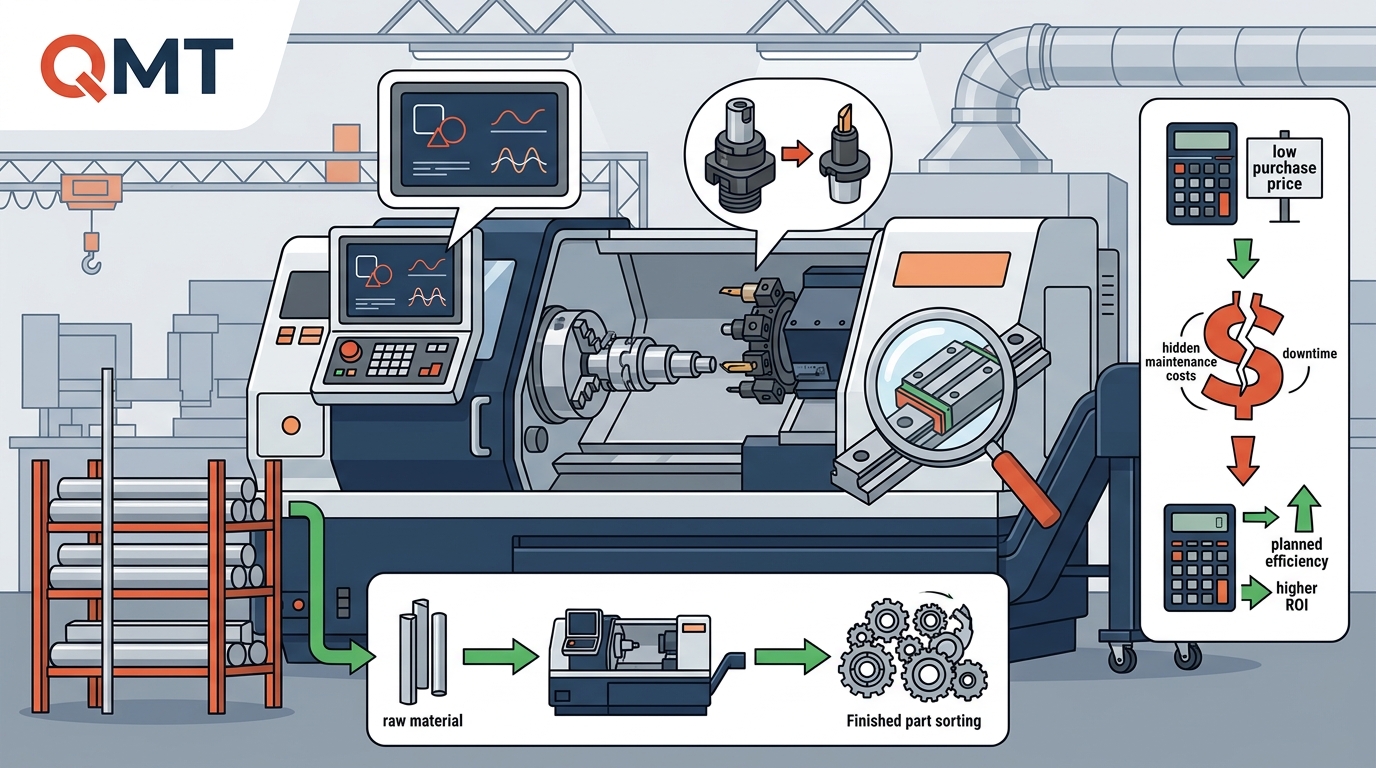
The sticker price of a CNC lathe is just the beginning of the financial equation. Total cost of ownership (TCO) includes energy consumption, maintenance, tooling, and potential downtime costs. Machines that appear cheaper upfront may incur higher operational expenses due to inefficiency or frequent repairs. Quality without compromise ensures long-term value and performance.
At QMT, we do not make money out of after-sales service. Instead, we pour our energy into ensuring that every brand we introduce meets a stringent set of performance and reliability criteria. If a machine does not prove itself to be of the highest quality, it simply does not make it into our catalogue. By prioritizing quality over initial cost, you invest in a machine that will deliver consistent results and minimize hidden expenses.
5. Misinterpreting Technical Specifications
Technical datasheets can be misleading if not interpreted correctly. Terms like "rapid traverse rate" or "repeatability" must be understood in the context of your specific applications. For instance, a high rapid traverse rate is beneficial for reducing non-cutting time, but it must be balanced with the machine's rigidity and stability. Accurate interpretation of specs prevents operational bottlenecks.
Consider the spindle speed range, tool capacity, and control system compatibility. Ensure that the machine's control system is user-friendly and supports the programming languages you use. Additionally, verify the machine's ability to handle the specific materials you work with, such as stainless steel or titanium, which require different cutting parameters and tooling. Consulting with experts can help clarify these specifications and ensure they align with your production goals.
Comparison of Lathe Types and Use Cases
Selecting the right type of lathe is crucial for optimizing your workshop's efficiency. The table below summarizes the primary categories of lathes available and their ideal applications.
| Lathe Type | Key Characteristics | Ideal Use Case | Best For |
|---|---|---|---|
| CNC Lathe | Automated, high precision, multi-axis options | Complex parts, high volume production | General engineering workshops |
| Manual Lathe | Operator-controlled, flexible, lower cost | Low volume, prototyping, repair work | Small workshops, educational institutions |
| Turning Centre | Integrated milling capabilities, high rigidity | Complex geometries, one-setup machining | Aerospace and medical manufacturing |
Key Takeaways
- Historical Stability: QMT Machinery was founded in 1967, providing over four decades of continuous service to the Australian manufacturing sector.
- Brand Integrity: We partner only with manufacturers that meet stringent qualification processes, ensuring proven industry experience and reliability.
- Service Excellence: Our commitment includes market-leading service with expert technicians and genuine parts availability since our inception.
- Value Proposition: We bridge the gap between low-cost imports and high-end OEMs, offering unmatched value for workshops and educational institutions.
- Technical Support: Access to remote diagnostics and on-call internet-based service ensures minimal downtime for our customers.
- Product Range: Our catalog includes manual milling machines, machining centres, large machining centres, and various turning machines to suit diverse needs.
- Customer Focus: We tailor solutions to work for your budget and goals, prioritizing your success as much as you do.
Frequently Asked Questions
What is the difference between a CNC lathe and a manual lathe?
A CNC lathe uses computer numerical control to automate the machining process, offering higher precision and repeatability for complex parts. A manual lathe requires operator control for each movement, making it more suitable for simple tasks or prototyping.
How does QMT Machinery ensure the quality of its brands?
QMT Machinery partners only with manufacturers that meet a stringent qualification process. Every brand we offer is proven through decades of industry experience, supported by service teams, and built with manufacturing excellence.
What is the importance of after-sales service in machine purchasing?
After-sales service ensures that your machine remains operational through timely repairs, genuine parts, and expert technical support. It is the backbone of trust and long-term performance in manufacturing.
Can QMT Machinery provide remote diagnostics for CNC machines?
Yes, QMT Machinery offers remote diagnostics via internet-based machine tool service. This allows for real-time insights and unprecedented efficiency in troubleshooting and maintenance.
What types of lathes does QMT Machinery supply?
We supply a comprehensive range of lathes including manual lathes, CNC lathes, and turning centres, catering to various workshop sizes and production requirements.
How does QMT Machinery support educational institutions?
We tailor solutions for educational institutions, providing reliable, high-performance equipment that fits their budget while meeting the rigorous training needs of tomorrow's metalworkers.
What is the total cost of ownership for a CNC lathe?
Total cost of ownership includes the initial purchase price, energy consumption, maintenance, tooling, and potential downtime costs. Focusing on quality can reduce long-term expenses by minimizing repairs and maximizing efficiency.
Why should I choose QMT Machinery over other suppliers?
QMT Machinery offers global brands backed by Aussie hands, market-leading service, outstanding brand partnerships, and unmatched value. Our longevity since 1967 is a testament to our integrity and customer trust.
Contact QMT Machinery for Expert Advice
Don't let common purchasing mistakes impact your workshop's productivity. Partner with a team that values your success as much as you do. Visit our Contact Us page to speak with our experienced team or explore our Products catalog to find the perfect CNC lathe for your needs. Learn more about our history and commitment to quality.