
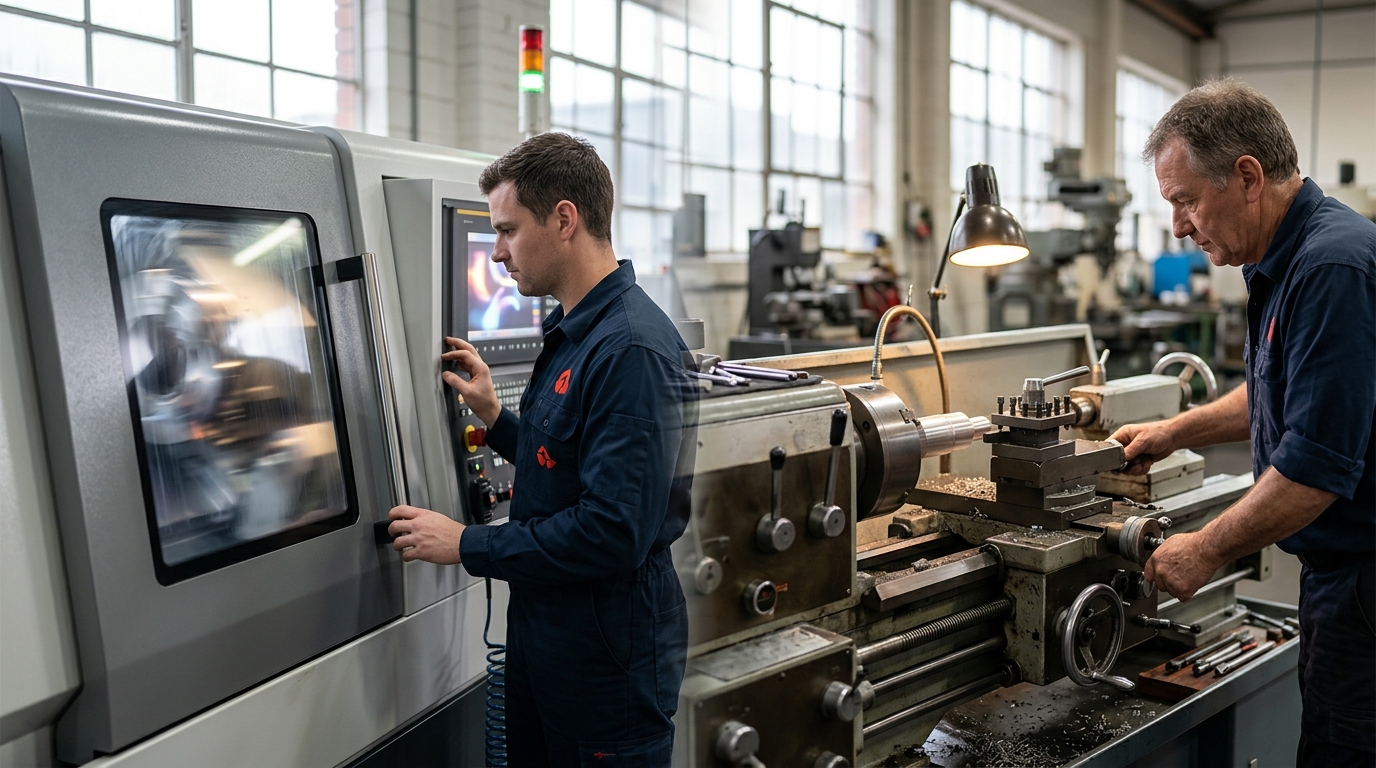
Choosing the right turning equipment is one of the most critical financial decisions a workshop owner makes. Manual lathes remain a cornerstone of precision machining for general engineering tasks, while CNC lathes dominate high-volume production environments. The decision between these two technologies depends entirely on your volume, complexity, and budget constraints.
Core Differences in Operation
The fundamental distinction lies in how the cutting tool interacts with the workpiece. A manual lathe relies on the operator's hand to control the feed rate and depth of cut. This direct physical connection allows for immediate tactile feedback, which is invaluable for troubleshooting or making micro-adjustments on the fly. Manual lathes are celebrated for their simplicity and reliability in low-volume settings. (Why QMT About us)
In contrast, a CNC (Computer Numerical Control) lathe operates via pre-programmed G-code. The machine controls every axis of movement with electronic precision. This automation eliminates human error in repetitive motions, ensuring that every part in a batch is identical. For Australian workshops handling tight tolerances, the consistency offered by CNC technology is often non-negotiable. (QMT Machinery Quality Machine)
According to industry data, the adoption of CNC machinery has increased by over 30% in the last decade among small-to-medium enterprises seeking to scale production. This shift highlights the growing demand for automated efficiency in modern manufacturing.
Precision and Geometric Complexity
When it comes to geometric complexity, CNC machines hold a significant advantage. Complex profiles, such as intricate contours or multi-stage tapers, are difficult to achieve manually without extensive setup time and specialized tooling. A CNC lathe can execute these profiles seamlessly by coordinating multiple axes simultaneously.
However, manual lathes are not obsolete. They excel in simple turning operations, facing, and threading where the part geometry is straightforward. For one-off prototypes or repair jobs, the setup time for a CNC program might outweigh the machining time itself. In these scenarios, the speed of manual operation provides a distinct operational edge.
Recent studies on manufacturing efficiency indicate that for batches under 50 units, manual machining often remains more cost-effective due to lower programming overhead. Conversely, for batches exceeding 100 units, the per-unit cost of CNC machining drops significantly due to reduced labor input.
Cost Analysis: Upfront vs Long-Term
The financial landscape of machine tool acquisition is complex. Manual lathes typically require a lower initial capital investment. They are mechanically simpler, meaning fewer expensive electronic components are prone to failure. Maintenance is often straightforward and can be handled by in-house technicians with basic mechanical knowledge.
CNC lathes command a higher upfront price due to their sophisticated control systems, servo motors, and spindle drives. However, the long-term return on investment (ROI) can be substantial. Reduced labor costs, faster cycle times, and less material waste contribute to a quicker payback period for high-volume producers.
QMT Machinery emphasizes that quality machines should not come with a premium price tag that compromises reliability. We bridge the gap between low-cost imports and high-end OEMs by offering brands that deliver real value. Our brand partnerships ensure that every CNC and manual lathe meets stringent performance criteria.
Skill Requirements and Training
Operating a manual lathe requires years of apprenticeship and tactile experience. The operator must understand metallurgy, cutting speeds, and feed rates intuitively. This deep technical knowledge is a valuable asset but is becoming increasingly scarce in the modern workforce.
CNC operation requires a different skill set. Operators need proficiency in programming, CAD/CAM software, and digital troubleshooting. While the barrier to entry for basic operation is lower, mastering advanced CNC programming requires dedicated training. Many Australian workshops are now investing in training programs to upskill their workforce in digital manufacturing technologies.
The Chisholm Institute, located in Dandenong Victoria, is a prime example of an institution empowering tomorrow’s metalworkers with these exact skills. Their curriculum bridges the gap between traditional machining and modern CNC automation.
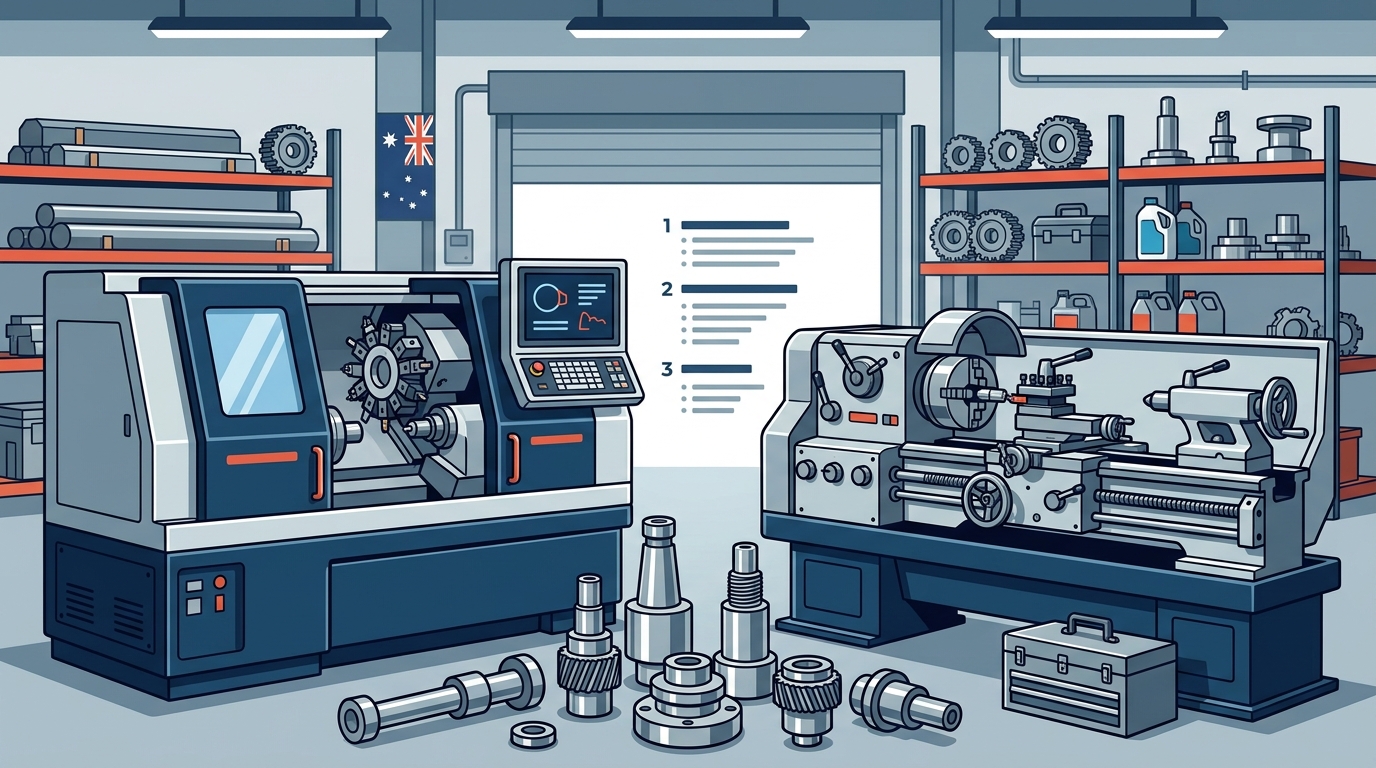
Comparison Summary
| Feature | Manual Lathe | CNC Lathe |
|---|---|---|
| Initial Cost | Low to Moderate | High |
| Operational Speed | Slow (Manual Feed) | Fast (Automated Feed) |
| Complexity | Simple Profiles | Complex 3D Profiles |
| Setup Time | Quick | Long (Programming) |
| Maintenance | Mechanical | Electronic & Mechanical |
| Best For | Prototypes & Repairs | High-Volume Production |
Key Takeaways
- Manual lathes offer superior tactile feedback and lower upfront costs for general engineering tasks.
- CNC lathes provide unmatched consistency and speed for high-volume production runs.
- QMT Machinery has served the Australian market since 1967, ensuring long-term reliability.
- Complex geometries require CNC automation to achieve within tight tolerances.
- Training in CNC programming is essential for modern workshop scalability.
- Remote diagnostics can significantly reduce downtime for CNC equipment.
- Choosing the right machine depends on your specific batch sizes and part complexity.
Frequently Asked Questions
Is a CNC lathe worth the investment for a small workshop?
For small workshops producing high-volume or complex parts, the efficiency gains often justify the cost. However, for low-volume, custom jobs, a manual lathe may be more practical.
What is the main advantage of a manual lathe over CNC?
The primary advantage is flexibility. Manual lathes allow for quick adjustments and are ideal for one-off repairs or prototypes where programming time would be inefficient.
How does QMT Machinery support CNC machine owners?
We offer market-leading service including remote diagnostics, expert technician support, and a comprehensive inventory of genuine parts to ensure minimal downtime.
Can a manual lathe achieve CNC-level precision?
While skilled operators can achieve high precision, manual lathes cannot match the consistent repeatability of a CNC machine across large batches.
What brands of lathes does QMT Machinery stock?
We stock reputable global brands such as King Rich and Vision Wide, selected for their durability and performance in the Australian market.
Is training required to operate a CNC lathe?
Yes, operators need training in G-code programming and machine setup. Many technical colleges offer specialized courses for this purpose.
How often do CNC lathes require maintenance?
Regular maintenance is crucial. We recommend following the manufacturer's schedule for lubrication, filter changes, and electronic system checks to prevent costly failures.
Contact QMT Machinery
Ready to upgrade your workshop capabilities? Whether you need a robust manual lathe for general engineering or a high-precision CNC turning centre for production, QMT Machinery has the solution. Our team of experienced technicians is ready to assist you with expert advice and tailored equipment packages.
Contact us today to discuss your specific machining needs and discover how our market-leading service can support your business growth.