
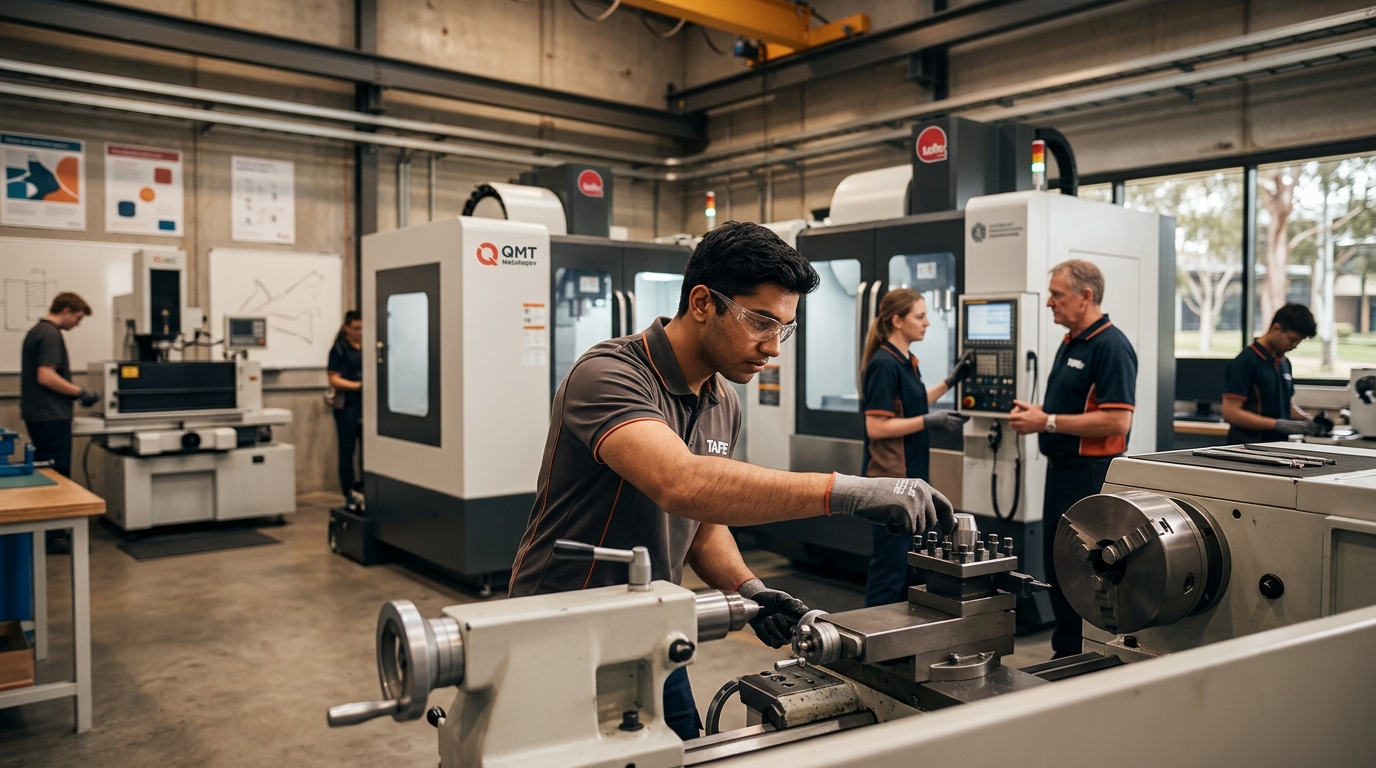
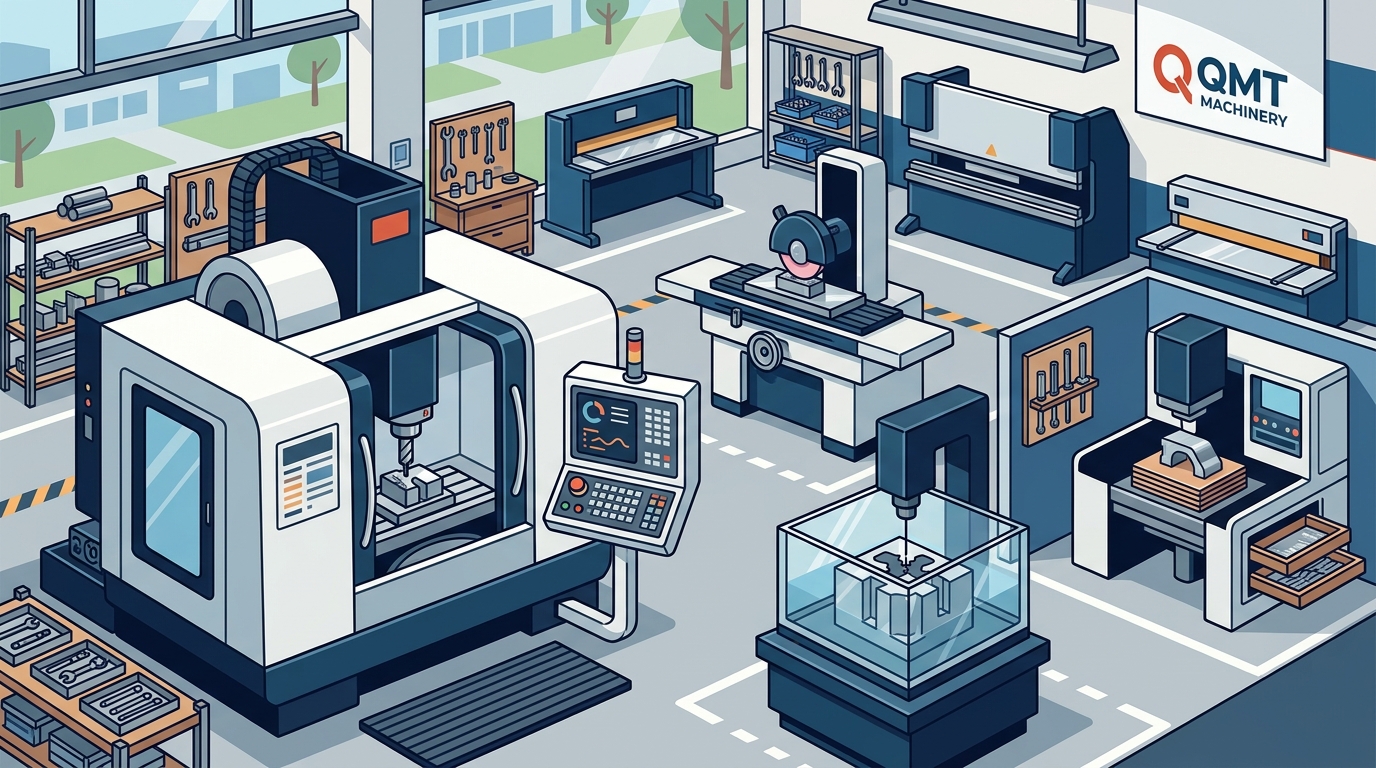
Australian TAFEs and universities primarily use CNC machining centres, wire EDM, surface grinders, sheet metal equipment, and additive manufacturing systems to train students in modern manufacturing. QMT Machinery supplies these specific machine categories to educational institutions across Melbourne, Sydney, and Perth. This guide details the specific roles each machine type plays in vocational and higher education curricula.
CNC Machining Centres
CNC machining centres are the backbone of modern manufacturing education. These machines allow students to learn computer-aided manufacturing (CAM) programming and multi-axis machining strategies. In Australian TAFEs, vertical machining centres (VMCs) are the most common entry point for CNC training.
Vertical Machining Centres (VMCs)
VMCs are ideal for teaching fundamental CNC concepts such as tool paths, coolant management, and workholding. QMT Machinery supplies compact VMCs that fit within standard workshop footprints while providing industrial-grade rigidity. These machines often feature automatic tool changers (ATC), which teach students the workflow of production environments.
Horizontal Machining Centres (HMCs)
For advanced diploma and degree programs, horizontal machining centres introduce pallet changers and 4-axis or 5-axis machining. These systems are critical for training students in complex part production, such as aerospace components and automotive engine parts. The ability to machine multiple faces in a single setup is a key competency taught using HMCs.
Wire EDM
Wire Electrical Discharge Machining (Wire EDM) is a non-traditional machining process used to cut conductive materials with extreme precision. In educational settings, Wire EDM is essential for teaching students how to manufacture complex geometries that are impossible to achieve with conventional cutting tools.
Tooling and Die Making
Wire EDM is the primary machine used in tool and die making courses. Students learn to cut intricate shapes in hardened tool steels for injection moulds and stamping dies. The process teaches patience and precision, as the wire must navigate tight corners without breaking.
Advanced Geometries
Surface Grinders
Surface grinding is a finishing process that uses an abrasive wheel to create a flat, smooth surface on a workpiece. It is a critical skill in precision engineering, as many components require flatness and surface finish tolerances that cannot be achieved by milling alone.
Manual vs. CNC Grinding
Many TAFEs use manual surface grinders to teach the fundamentals of wheel dressing, feed rates, and thermal control. As students progress, they move to CNC surface grinders, which automate the grinding process for high-volume production. This transition mirrors the industry shift from manual craftsmanship to automated precision.
Material Science Applications
Grinding is also used to prepare samples for metallography. Students learn how to section, grind, and polish materials to examine their microstructure. This application is vital for materials science and engineering courses.
Sheet Metal Equipment
Sheet metal fabrication is a major sector in Australian manufacturing, particularly in construction, automotive, and aerospace. Educational institutions use a variety of equipment to train students in cutting, forming, and joining sheet metal.
CNC Plasma and Laser Cutting
CNC plasma cutting systems are widely used in TAFEs for teaching 2D cutting of conductive materials. They are cost-effective and robust, making them ideal for high-usage educational environments. Laser cutting systems are also common, offering higher precision and cleaner edges for advanced projects.
Press Brakes and Bending
Press brakes are essential for teaching sheet metal forming. Students learn to calculate bend allowances, manage tooling, and achieve precise angles. QMT Machinery supports educational institutions with sheet metal equipment that balances safety and functionality for student use.
Additive Manufacturing
Additive manufacturing, or 3D printing, is increasingly integrated into manufacturing curricula. It allows students to design and produce complex parts without the need for traditional tooling. This technology is used for prototyping, functional parts, and educational demonstrations.
Metal 3D Printing
Metal 3D printers, such as those using Selective Laser Melting (SLM) or Electron Beam Melting (EBM), are used in universities for research and advanced training. These machines produce high-strength parts in materials like titanium and aluminium. QMT Machinery supplies metal 3D printers that are suitable for both R&D and production environments.
Plastic and Composite Printing
Fused Deposition Modelling (FDM) and Stereolithography (SLA) printers are common in TAFEs for rapid prototyping. They allow students to iterate on designs quickly and cost-effectively. These machines are often used in design and engineering courses to bridge the gap between digital design and physical production.
Comparison of Educational Machine Tools
| Machine Type | Primary Educational Use | Key Skills Taught | Typical Application |
|---|---|---|---|
| CNC VMC | Entry-level CNC training | CAM programming, tool paths | General engineering, prototyping |
| Wire EDM | Tool and die making | Precision cutting, electrode design | Moulds, dies, complex parts |
| Surface Grinder | Finishing and metrology | Wheel dressing, flatness control | Precision components, sample prep |
| CNC Plasma | Sheet metal cutting | 2D cutting, nesting | Structural components, enclosures |
| Metal 3D Printer | Advanced prototyping | Additive design, post-processing | Aerospace, medical, R&D |
Key Takeaways
- CNC machining centres are the core of modern manufacturing education, teaching both vertical and horizontal machining strategies.
- Wire EDM is essential for tool and die making, enabling the production of complex geometries in hardened materials.
- Surface grinders teach precision finishing and are used for both component production and metallography sample preparation.
- Additive manufacturing systems, from FDM to metal 3D printers, are integrated into curricula for prototyping and research.
- QMT Machinery supplies these machine categories to Australian TAFEs and universities, ensuring access to reliable, mid-to-high tier equipment.
- Local support and service are critical for educational institutions, as downtime impacts student learning outcomes.
- Choosing the right machine depends on the specific curriculum goals, from entry-level vocational training to advanced university research.
Frequently Asked Questions
What is the most common CNC machine in Australian TAFEs?
The vertical machining centre (VMC) is the most common CNC machine in Australian TAFEs. It provides a robust platform for teaching fundamental CNC programming and machining skills.
Why do universities use Wire EDM?
Universities use Wire EDM to teach precision cutting of conductive materials. It is essential for courses in tool and die making and advanced manufacturing, where complex geometries are required.
Are surface grinders still relevant in modern manufacturing education?
Yes, surface grinders remain relevant for teaching precision finishing and flatness control. They are used in both manual and CNC configurations to prepare students for high-tolerance industries.
What sheet metal equipment is used in TAFEs?
TAFEs commonly use CNC plasma cutting systems and press brakes for sheet metal training. These machines teach students cutting, nesting, and forming skills.
How is additive manufacturing used in manufacturing courses?
Additive manufacturing is used for rapid prototyping and functional part production. Students learn design for additive manufacturing and post-processing techniques.
Does QMT Machinery supply machines to educational institutions?
Yes, QMT Machinery supplies machine tools to TAFEs and universities across Australia. We provide installation, training, and ongoing support to ensure educational programs run smoothly.
What is the difference between a VMC and an HMC in education?
A VMC is used for entry-level CNC training, while an HMC is used for advanced multi-axis machining. HMCs teach students how to machine complex parts in a single setup.
Can metal 3D printers be used in TAFEs?
Yes, metal 3D printers are used in some TAFEs and universities for advanced prototyping and research. They allow students to produce high-strength parts in materials like titanium.
Conclusion
Australian TAFEs and universities rely on a diverse range of machine tools to prepare students for the modern manufacturing industry. From CNC machining centres to additive manufacturing systems, each machine type plays a specific role in the curriculum. QMT Machinery is committed to supporting educational institutions with reliable, mid-to-high tier equipment and local service. To discuss your institution's machine tool needs, .